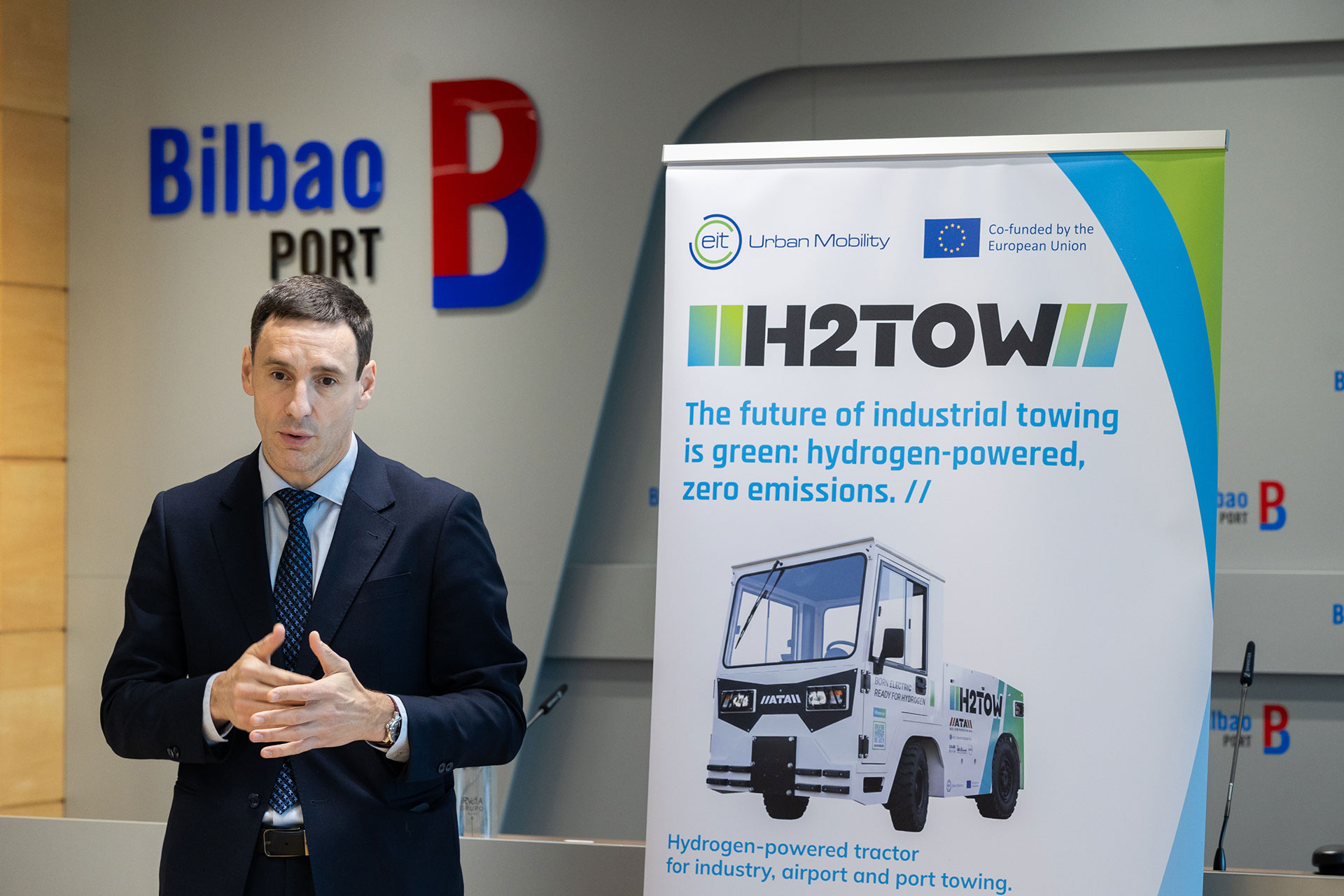
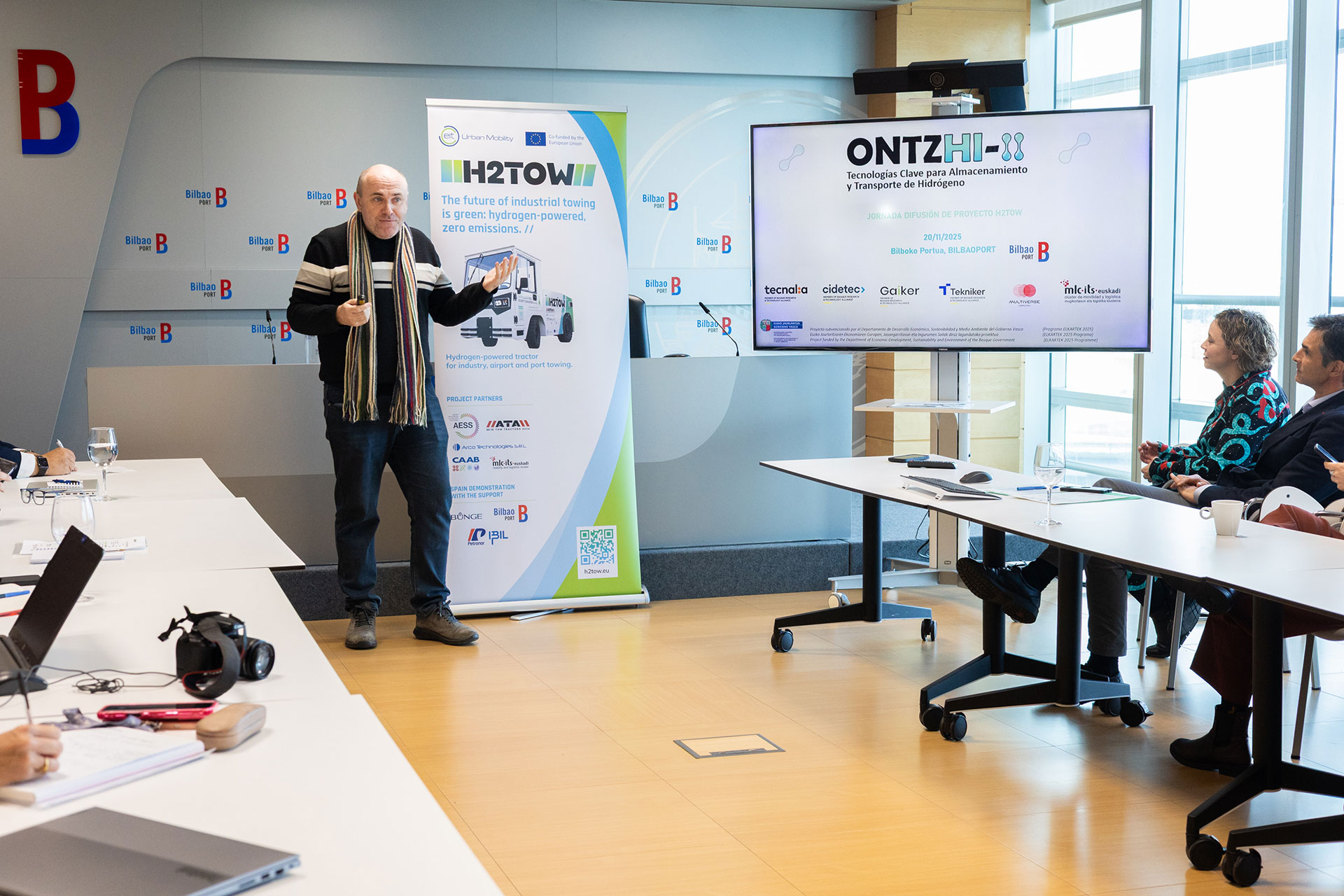
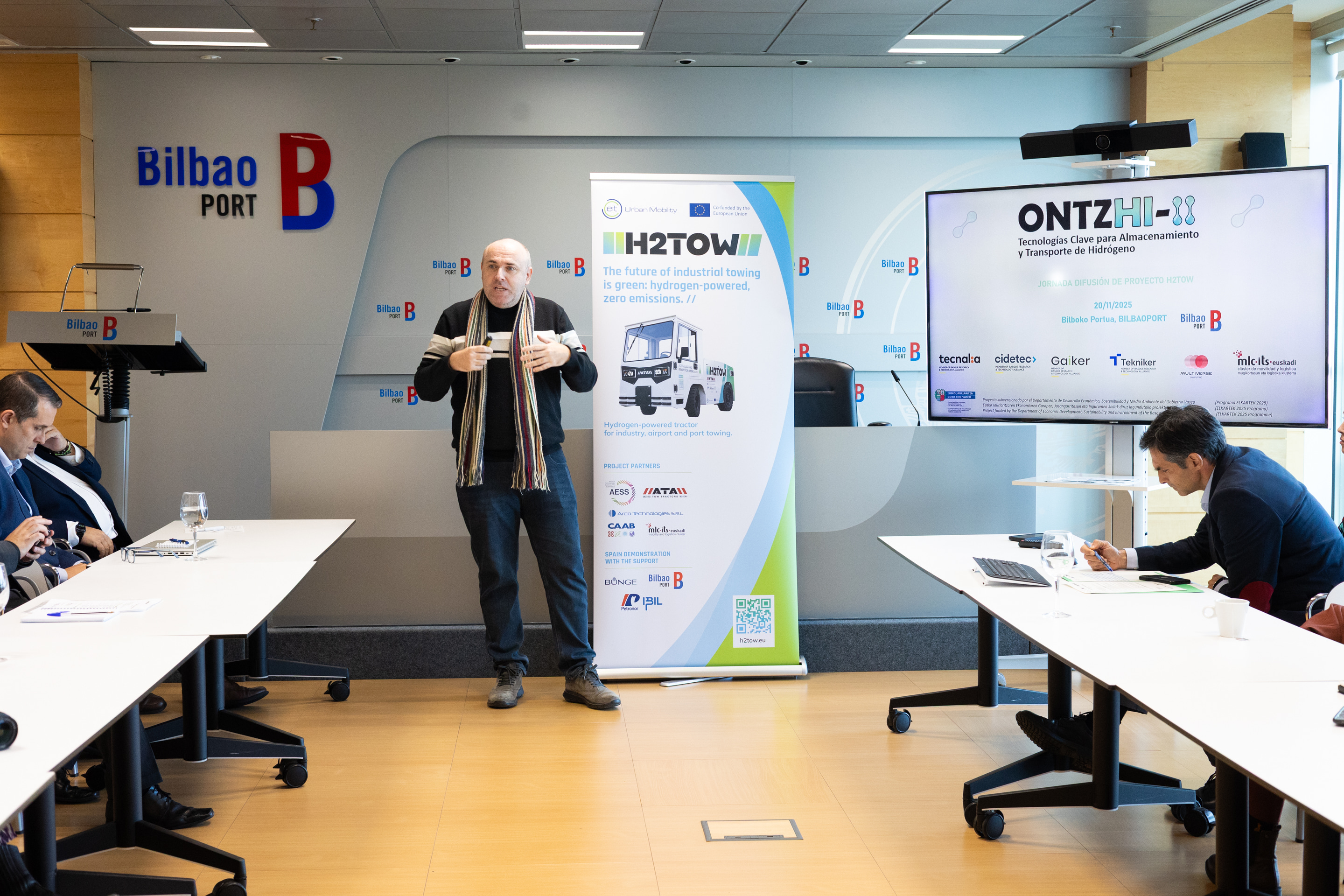
On November 20th, ONTZHI actively participated in a conference focused on the deployment of hydrogen in logistics and port applications, held at the Port of Bilbao within the framework of the European project H2TOW (+). The event brought together companies, technology centres and entities from the Basque hydrogen ecosystem, offering a comprehensive view of the advances, challenges and opportunities that this technology is generating in the Basque Country.
Iñaki Eguía (TECNALIA) presented the progress of the ONTZHI project and its new phase, ONTZHI-II, highlighting the relevance of scientific knowledge as the foundation for developing safe, sustainable and competitive solutions for hydrogen storage, transport and distribution.
Scientific and technological challenges presented
During the presentation, TECNALIA outlined—based on the results of the first phase—the main challenges that still limit the deployment of hydrogen in real infrastructures, especially in industrial and port environments. Among these challenges, the following were highlighted:
- Hydrogen-induced embrittlement mechanisms in steels and welds, a complex phenomenon requiring advanced characterisation and predictive modelling to prevent structural failures.
- Permeation and leakage in metallic and polymeric materials, with consequences both for safety and operational efficiency.
- The lack of standardised methods to compare hydrogen charging in gaseous phase and in electrochemical charging, a critical challenge for industry and research.
- The need to design sustainable and competitive tanks, especially composite-material tanks for mobility applications.
- The opportunity offered by advanced simulation models — including quantum approaches and AI — to accelerate the understanding of phenomena at the atomic scale.
These topics align with the results presented, which detail progress in modelling, gaseous/electrochemical charging equivalence, ceramic and metallic barriers, and concepts for recyclable thermoplastic tanks.
The role of ONTZHI-II in the Basque hydrogen ecosystem
Iñaki Eguía explained how ONTZHI-II (2025–2027) builds upon the challenges identified during the first phase and opens new lines of research in:
- Barrier coatings on metals to reduce embrittlement and permeation.
- Sustainable composite materials applied to type-IV tanks.
- Analysis of welds, corrosion and behaviour in gaseous hydrogen pipelines.
- Advanced characterisation and modelling methodologies for degradation mechanisms.
- Conceptual developments and laboratory-scale demonstrators that will serve as a basis for future industrial advances.
His presentation helped position ONTZHI within the broader set of strategic initiatives in the Basque Country, reinforcing its complementarity with other projects — such as H2TOW — that are already demonstrating the real potential of hydrogen in logistics and port operations.
An event that fosters public–private collaboration
The conference showcased real examples of hydrogen applications, such as:
- The H2TOW port tractor, currently being tested in the BilbaoPort area.
- The retrofit project for RTG cranes using fuel cells.
- Progress made by key companies in green hydrogen, refuelling infrastructure and synthetic fuels.
For ONTZHI, it was a valuable opportunity to strengthen synergies with industrial stakeholders, contrast real market needs and showcase the project’s purpose: to generate cutting-edge knowledge enabling the design of safer and more sustainable solutions for hydrogen storage and transport.