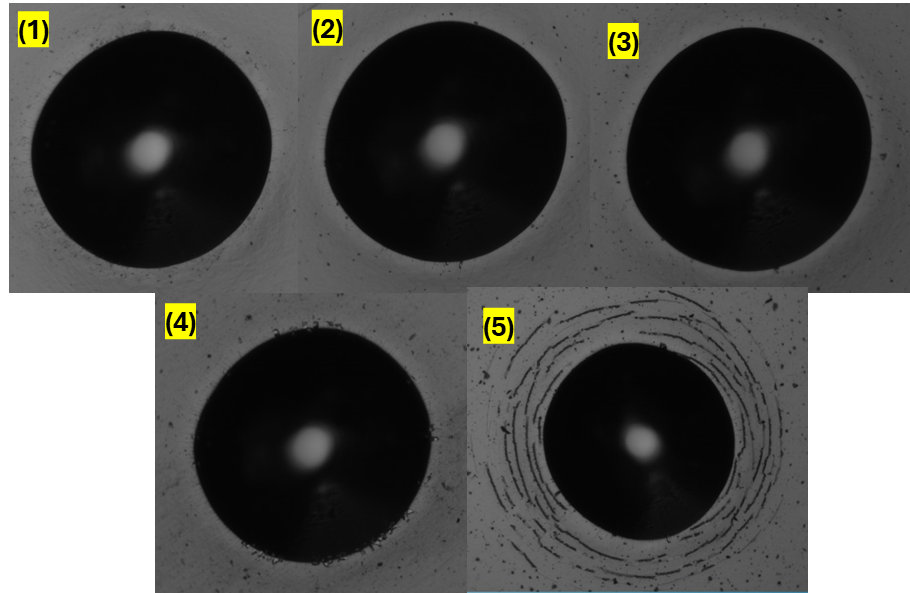
When considering the reuse of existing carbon steel infrastructures for hydrogen transport (pipelines that have been in service for years and inevitably show signs of surface corrosion), a critical question arises: how does that oxide layer affect the material's behaviour in the presence of hydrogen? The intuitive answer would be that corrosion makes things worse. The results obtained by TECNALIA within ONTZHI-II point in the opposite direction.
Material and test conditions
The material studied is normalised X52N steel (API 5L), supplied by Tubos Reunidos Group in the form of a seamless tube with an outer diameter of 600 mm and a wall thickness of 25 mm — a steel representative of gas distribution and transport networks, with a ferrite-pearlite microstructure and well-characterised mechanical properties (yield strength: 384 MPa, tensile strength: 532 MPa).
The test specimens were subjected to four different surface ageing conditions before being tested in pure hydrogen at 160 bar by slow strain rate tensile testing (SSRT):
- SE: No ageing — clean and polished specimens, used as reference.
- E1: 24 hours of salt spray (according to UNE-EN ISO 9227:2023).
- E2: 72 hours of salt spray.
- E3: 336 hours (14 days) in an environmental chamber at 100% relative humidity and 40 °C.
Results: more corrosion, less embrittlement
SSRT tests in hydrogen at 160 bar reveal a clear and surprising pattern: all surface ageing conditions improve the material's ductility in the presence of hydrogen compared to non-corroded steel. The most notable result is that of ageing condition E2 (72h salt spray), which shows a Rεpl embrittlement index of 0.97 — practically equivalent to behaviour in air — compared to 0.72 for the non-aged material.
Confirmed by fracture surface analysis
Scanning electron microscopy (SEM) analysis of the fracture surfaces provides the mechanistic explanation. In the non-aged specimen tested in hydrogen, a large semi-elliptical brittle crack is observed covering most of the fracture surface — the unmistakable signature of hydrogen embrittlement (HE). In contrast, the aged specimens show several smaller semi-elliptical brittle cracks distributed around the circumference. This behaviour could be related to a barrier effect of the oxide layer, which would redistribute and limit hydrogen penetration.
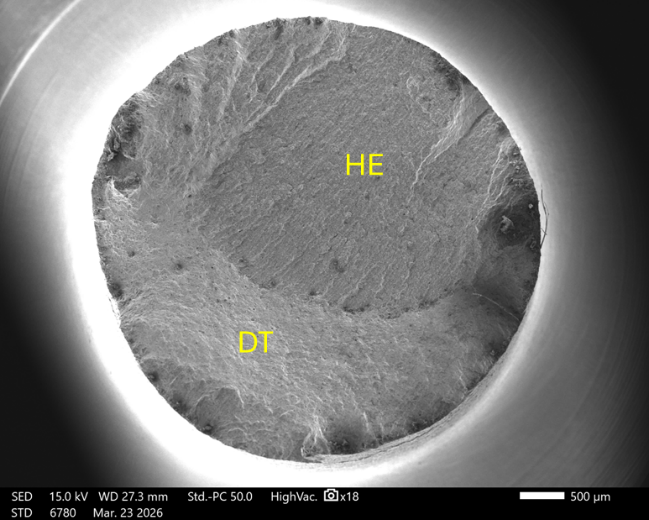
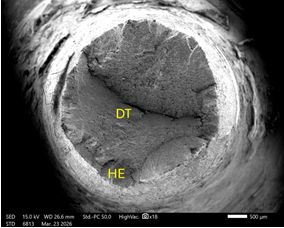
Figure 2. SEM fracture surfaces in hydrogen at 160 bar: SE (1º), E3 (2º). Ductile tearing zones (DT) and zones with evidence of hydrogen embrittlement (HE) are identified.
Implications for infrastructure repurposing
These results could have a relevant industrial implication: oxide layers formed by corrosion in X52N steel pipelines do not appear to worsen their behaviour in the presence of hydrogen and could exert a partial barrier effect against its penetration. Although this mechanism requires further investigation, these results provide a new perspective for evaluating the suitability of existing gas transport infrastructures for potential repurposing for hydrogen transport.
Download the full report with all results and analysis here: